Short answer
Custom jewelry packaging takes 7 steps. Brief the sizes and inserts for each piece, give Pantone colors, send vector logo files, choose finishes, approve a digital proof, test a physical sample, then order. Logo boxes from stock ranges often start at 24 to 100 units, and fully custom rigid boxes need larger runs.
- Steps
- 7, from brief to reorder
- Logo-printed stock boxes
- 24 to 100 units minimum at two suppliers, as of October 2026
- Custom printed tissue
- 10,000 sheets minimum at one supplier, as of October 2026
- Grandior
- Your box and inserts packed with every order, from 1 piece
In this guide9 sections
Custom jewelry packaging takes 7 steps: the brief, colors, logo files, finishes, a proof, a sample and the order. The step that costs brands money is the first one. Get the box sizes and insert slots right for every piece you sell and the rest is checking. Get them wrong and you own a few hundred boxes that don't fit your best seller.
I run my own fine-jewelry brands as well as Grandior, so I see custom packaging from both sides: the brand writing the brief, and the team that has to fit a piece into that box on every order. Branded packaging is one of the first things brands ask us about. This is the order I'd work in.
What goes into a custom jewelry packaging brief?
The inside of the box. A supplier can't quote properly without internal dimensions and insert details for each piece type.
- Dimensions per piece type. Measure the largest version you sell, in millimetres. Rings: the height of the tallest setting. Pendants: the pad size and how the chain is held. Bracelets: length laid flat, or a pillow. Earrings: hole spacing for studs and drops.
- Insert slots. A ring slit, earring holes, a hook or slit for pendants, an elastic for bracelets. Say if one box must hold a set.
- Colors. A Pantone reference for the board, lining, print and foil. The same Pantone looks different on uncoated paper, coated paper and fabric, so ask for swatches on the real material.
- Logo files. Vector files with fonts outlined. Foil and deboss need solid shapes; hairlines and gradients don't hold.
- Quantities per size. You'll rarely need as many necklace boxes as ring boxes.
- Where it ships. To you, a fulfillment partner or your manufacturer.
| Step | What you decide | What to send | Common mistake |
|---|---|---|---|
| 1. Brief | Box types and sizes per piece | Internal sizes in mm, photos of each piece | Sizing to the sample, not the biggest piece you sell |
| 2. Inserts | Slot, hook, card or pad | Ring heights, earring spacing, chain lengths | One insert for every piece type |
| 3. Color | Board, lining, print and foil colors | Pantone references | Approving color on a screen |
| 4. Artwork | Logo size and placement | Vector files, fonts outlined | Sending a PNG copied from the website |
| 5. Finish | Foil, emboss or deboss, spot UV, soft-touch | Finish per surface, foil color | Three finishes on one small lid |
| 6. Proof and sample | Approve or change | Signed proof, notes on the sample | Skipping the physical sample |
| 7. Order and reorder | Quantity per size, reorder level | Delivery address, storage plan | A year's boxes in an untested size |
Which finishes work on custom jewelry boxes with a logo?
Hot foil and a deboss cover most of what jewelry brands want. Add other finishes only where they'll show.
- Hot foil stamping. Metallic foil pressed on with a heated die. Gold, rose gold and silver are the usual choices; matte foils look quieter. Each foil color usually needs its own die and pass.
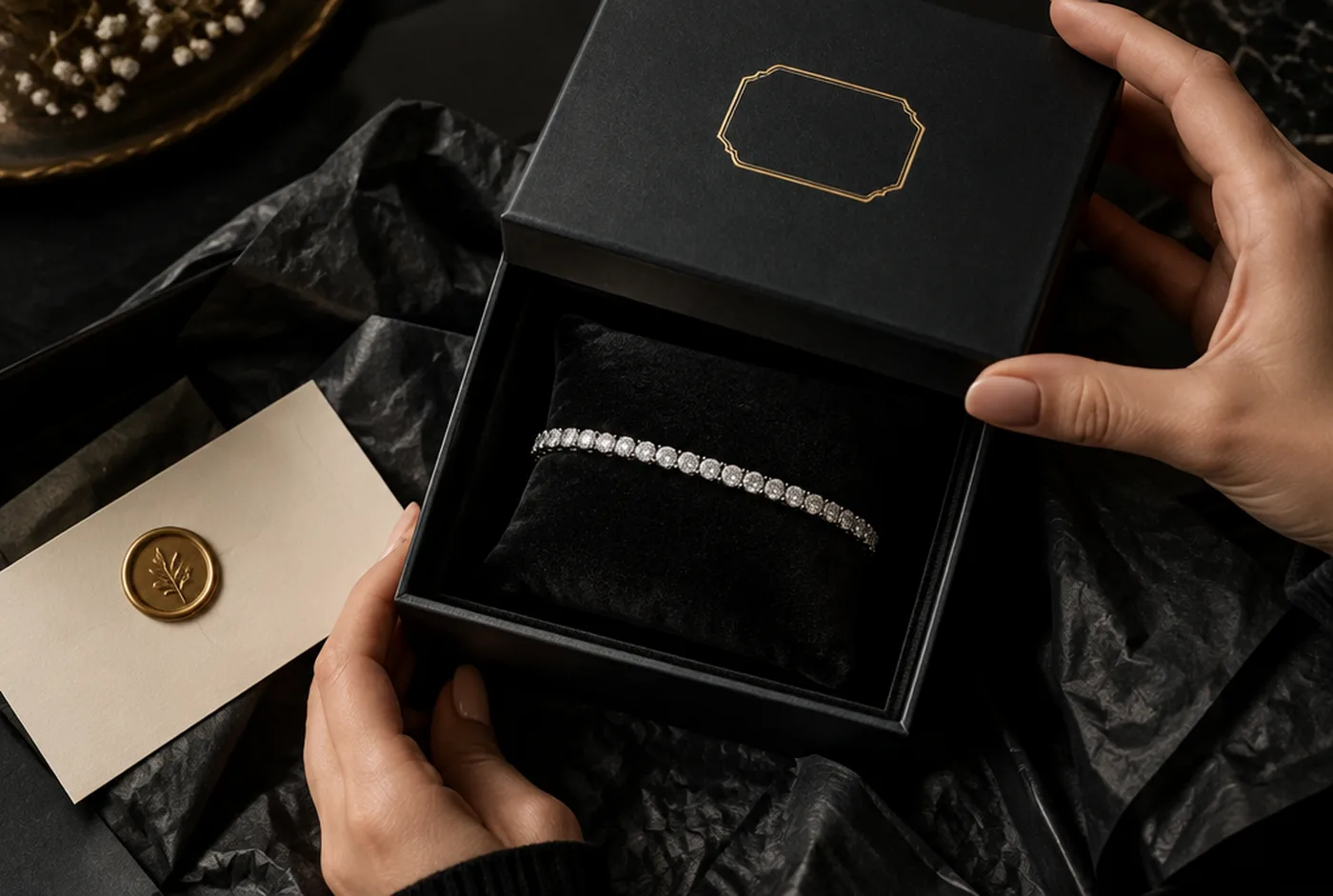
- Emboss and deboss. The logo raised out of the board, or pressed into it. A blind deboss, with no ink, is the most understated logo there is. Add foil for a crisp edge.
- Spot UV. Gloss varnish on part of a matte printed surface, such as a logo or a pattern. It suits smooth coated paper better than textured wraps.
- Soft-touch lamination. A matte film with a velvety feel and no glare in photos. It can scuff, so check it after a test shipment.
- Print inside. A line or pattern inside the lid or on the drawer base. Customers find it after opening, and it costs little.
How do proofs and samples work?
You approve twice: a digital proof, then a physical sample. Skip neither.
The digital proof is a flat dieline with your artwork, colors and foil areas marked. Check spelling, logo size, placement and which face is the front. Then get a pre-production sample. PakFactory, for one, highly advises samples for custom printed rigid boxes.
Put the real piece in the sample. Close it, shake it, ship it to yourself in your mailer, then photograph it under the lights you use for content. Check the foil edges, color in daylight, how the magnet or hinge closes, and whether the insert holds the piece upside down.
How long does custom jewelry packaging take?
Plan in weeks, not days, and confirm with your supplier. Lead times depend on the box, the finish, the quantity and the time of year. Fully custom boxes made overseas add sampling rounds and freight on top of production.
Count back from launch: brief, proof, sample, changes, production, freight, and a buffer before the holiday season. A second sample round adds another cycle, so book the work early.
What minimums should you expect, and how do you start small?
Expect minimums on everything. As of October 2026, Westpack sets 24 to 96 pieces for logo printing on its stock jewelry boxes, depending on the series, with larger minimums for custom-made packaging. Nashville Wraps lists 100 boxes per color for hot-stamped jewelry boxes. Custom printed tissue can be far higher: Packlane lists 10,000 sheets.
Start small and build up:
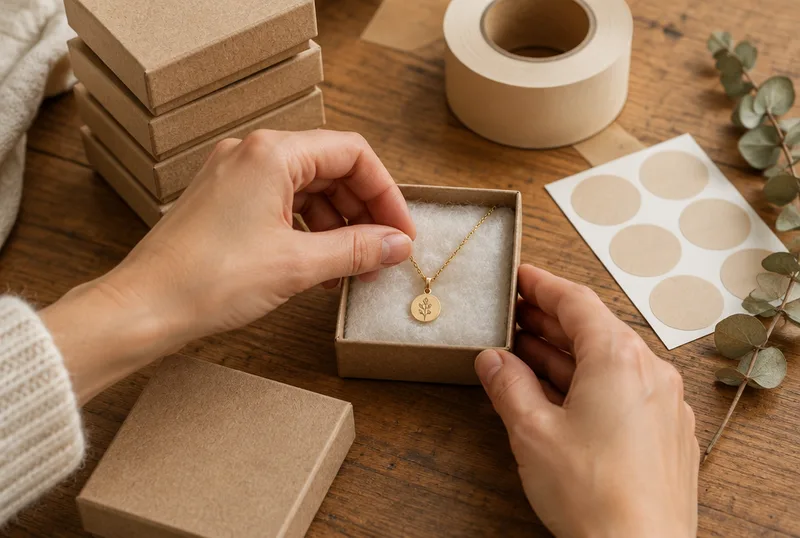
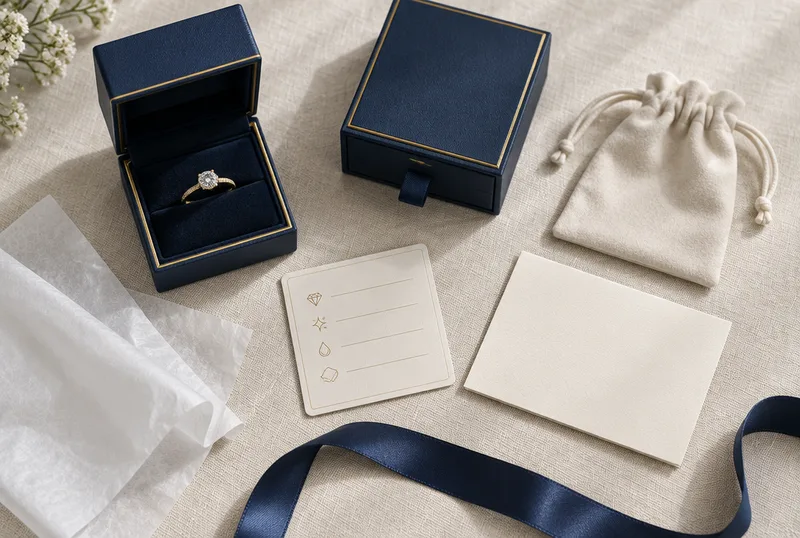
- Stock box with your sticker or seal. A navy or black stock box and a round foil sticker. The lowest commitment.
- Printed sleeve or belly band. Slides over a stock drawer box. Cheap to change when your branding does.
- Hot-stamped pouches. Your logo on suede or cotton.
- Custom cards. Care, thank-you and returns cards in your colors.
- Your logo on a stock box. Foil or print on a stock series.
- Custom rigid boxes. Once you know your best sellers and volumes.
How should you store packaging and handle reorders?
Keep it flat, dry and out of sunlight. Most rigid boxes arrive made up, so they take more shelf space than you expect.
Keep a one-page spec for each box: supplier, size, board, Pantone references, foil color, finish, insert and a photo of the approved sample. Reorders then match the first run. Set a reorder level that covers the supplier's lead time plus a buffer.
Keep the mailer tight to the box, too. UPS uses dimensional weight to price packages that are large for their weight, so an oversized carton costs more on every order.
How does Grandior handle custom jewelry packaging?
We pack your branded box, certificate and inserts with every order, one piece at a time. During onboarding we build your packaging, inserts and order workflow, and onboarding is quoted for your brand.
After that, each piece is made, checked against your approved sample, packed and dispatched within 7 days of confirmation. Your customer never sees Grandior. See how it works for private label jewelry and jewelry dropshipping.
For the layers, cards and price points, read our jewelry packaging guide. For ideas by brand type, see jewelry packaging ideas.
Next step
Send your logo, your colors and a list of the pieces you sell in a brief, or book a call to talk through packaging for your launch.
Questions founders ask
How do I get custom jewelry boxes with my logo?
Send a packaging supplier a brief with internal box sizes for each piece, insert details, Pantone colors and vector logo files. Choose the finish, approve a digital proof and a physical sample, then place the order.
What is the minimum order for custom jewelry boxes?
It varies by supplier and box. As of October 2026, Westpack lists 24 to 96 pieces for logo printing on its stock jewelry boxes, and Nashville Wraps lists 100 boxes per color for hot stamping. Fully custom boxes need larger runs.
What file format do packaging printers need for a logo?
A vector file, such as AI, EPS, SVG or a vector PDF, with fonts converted to outlines. A JPG or PNG from your website won't give clean foil or deboss edges.
What is the difference between emboss and deboss?
An emboss raises the logo out of the board. A deboss presses it in. Both can be blind, with no ink, or combined with foil.
How long does custom jewelry packaging take?
Plan in weeks, not days. Time depends on the box, the finish, the quantity, sampling and freight, so confirm the schedule with your supplier before you set a launch date.
What is the cheapest way to brand jewelry packaging?
Put your own sticker, sleeve or printed card on a good stock box, or use hot-stamped pouches. Move to custom rigid boxes once you know your best sellers and volumes.
Sources
Checked on October 31, 2026. Rules and rates change, so confirm with the source before you rely on a number.
- Westpack, FAQ on minimum order quantities for logo boxeswestpack.com
- Nashville Wraps, custom printed jewelry boxesnashvillewraps.com
- PakFactory, custom rigid boxes and samplespakfactory.com
- Packlane, custom tissue paperpacklane.com
- UPS, shipping dimensions and weightups.com
Get new guides by email
Practical guides for jewelry brands, from what we see on real orders. Only new guides; unsubscribe any time.