Short answer
An AI model photoshoot puts your real jewelry on a generated model, ear or hand, with no casting, studio day or model booking. The model can be invented; the piece must stay exactly as made. Grandior's AI Studio starts with a $75 trial, and a brand shoot with one AI model is $1,000 for up to 10 products.
- Trial
- $75 for 1 product, 4 images and 1 model video
- Brand photoshoot
- $1,000 for 40 images and 8 videos across 3 scenes
- Studio 50
- $1,500 with a custom scene and model style
- New York ads
- synthetic performers must be disclosed, in effect since June 2026
In this guide8 sections
An AI model photoshoot puts your real piece on a generated model, ear or hand. A young jewelry brand gets on-model images without casting, a studio day or hourly model fees. One rule matters more than the rest: the model can be invented, the jewelry can't. Start with 1 piece and check every stone, prong and millimeter against the one you ship.
I run my own fine-jewelry brands as well as Grandior. Brands that ask us about photos usually want the same thing: on-model images good enough for ads, ready for launch, without a model shoot they can't yet afford.
What is an AI model photoshoot for jewelry?
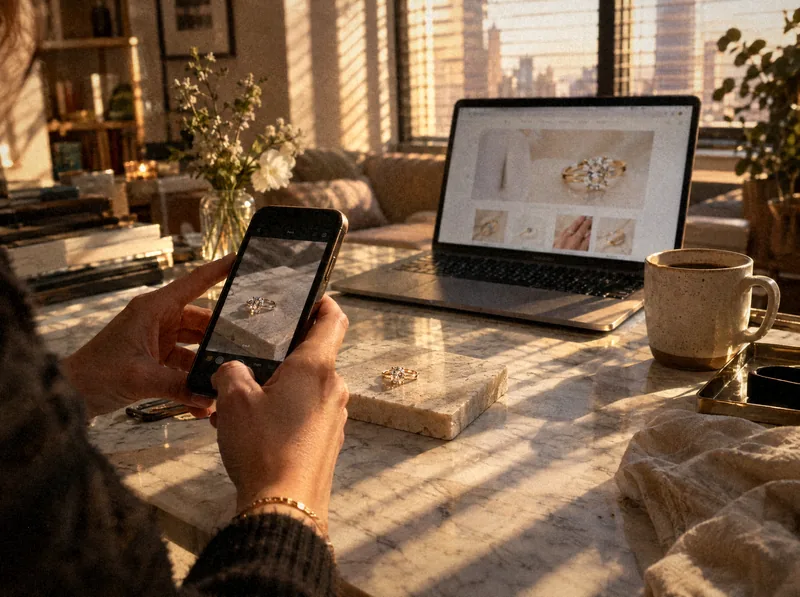
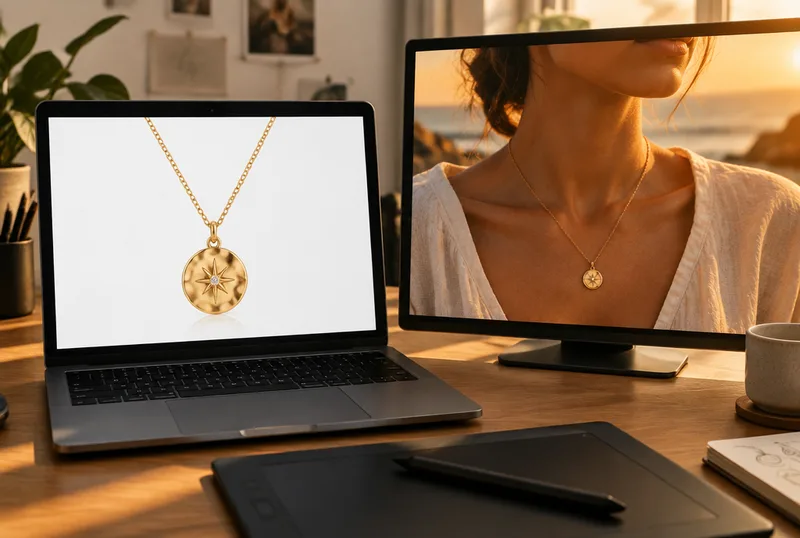
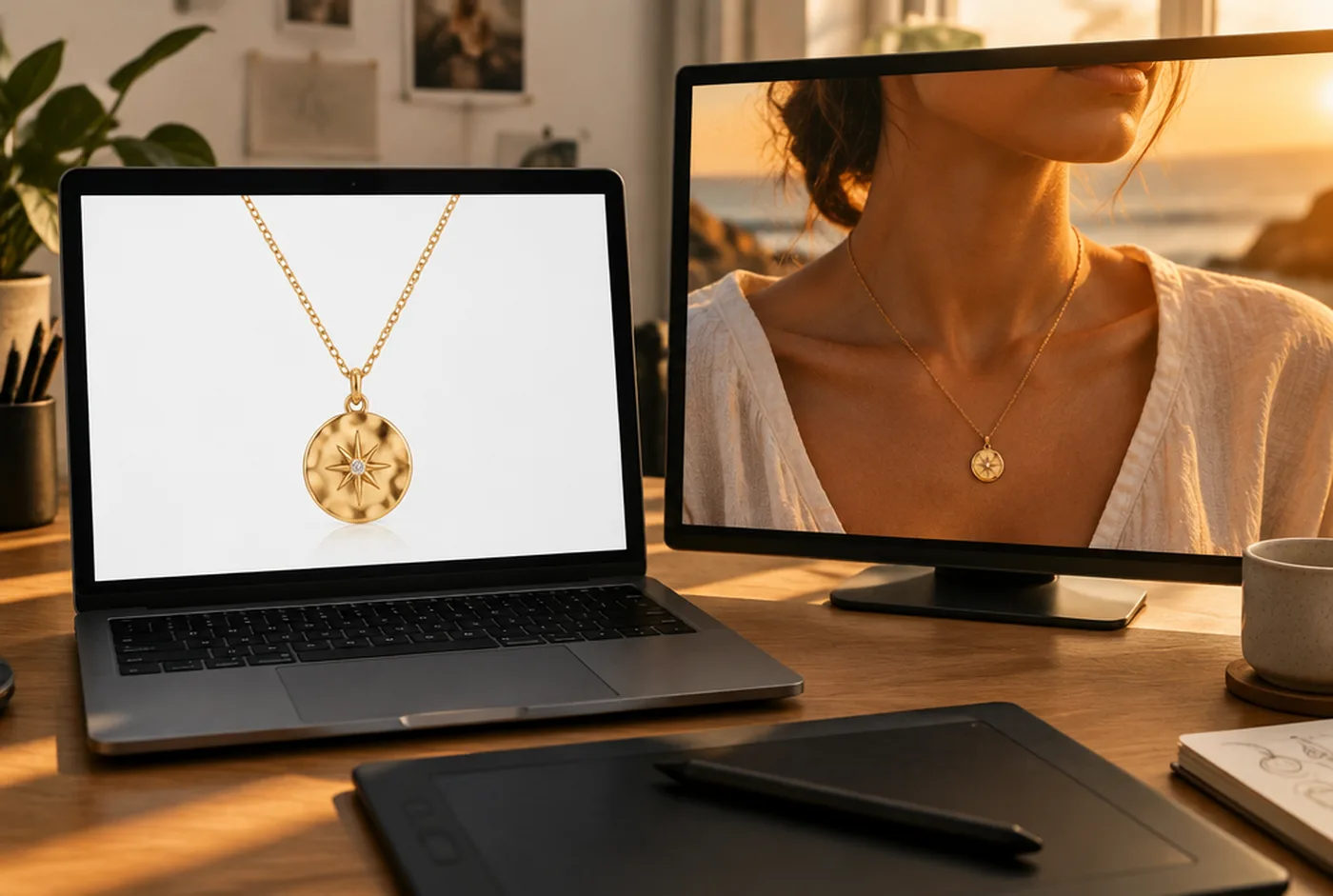
It's a set of on-model images made from photos of your product. You send the piece; the model, pose, light and scene are generated around it. Then the jewelry is retouched and checked against the real thing.
At our AI Studio it runs in four steps:
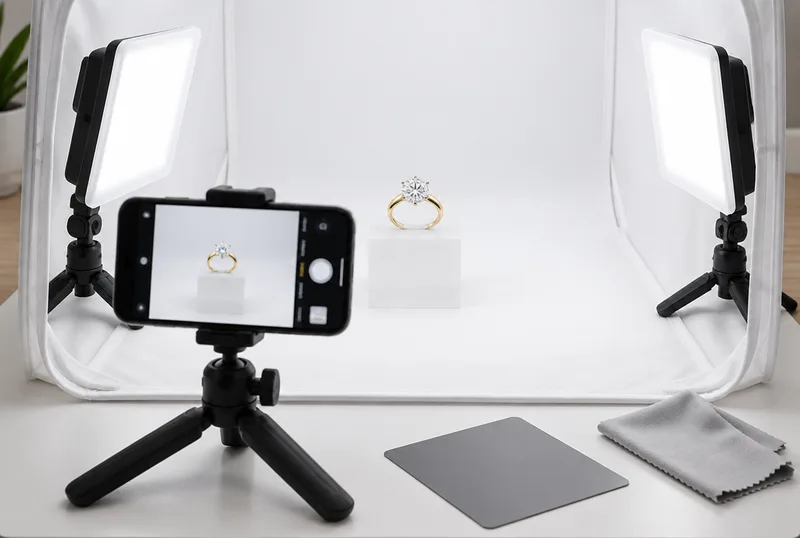
- Order and upload. Pick a pack. We email an upload link within one business day. Send two or three sharp photos of each piece on a plain background, or your existing product shots.
- Set the look. Studio 50 and the brand photoshoot start with a kickoff call. The brand shoot adds a moodboard, creative direction and 3 scenes.
- We create. Images are generated, retouched and checked so stones, prongs and metal match your piece.
- You approve. Changes are included. Files come sized for Shopify, Instagram, Meta ads and email.
Our gallery covers model videos, on hand, on ear, on model, lifestyle and product shots. For how AI product images are made in general, see our guide to AI product photography.
What does an AI model photoshoot replace?
Mostly the bookings around the product. A traditional on-model shoot means a model, hair and makeup, a studio and often a stylist, all billed before you see a frame.
| Line item | Traditional shoot (soona list prices) | AI model photoshoot (Grandior) |
|---|---|---|
| Model | Full-body $159 an hour, hand $79 an hour | Nothing to book |
| Hair and makeup | $299 per model | Not needed |
| Studio access | $149 studio pass per booking, for non-members | Not needed |
| Stylist | $149 an hour | Moodboard and direction in the brand shoot |
| Images | $39 per photo | 40 images in the $1,000 brand shoot |
| Video | $93 per clip | 8 videos in the brand shoot, or $20 per product video |
Prices from soona's pricing page, checked October 2026. Their own comparison describes traditional agency shoots as involving usage negotiation, fees and limited-time usage unless you pay more. soona's in-house models come with unlimited usage. Ours involve no real person, so there is no usage to negotiate. For a full cost comparison, read product photography cost.
How do you keep the jewelry true in AI model images?
Treat the jewelry as untouchable and everything else as flexible. An AI fashion model can have any pose, light or setting. The piece on her must be the one in your box.
Check every image for:
- Scale. A stud the size of a pea on one model and a lentil on another is a problem. The FTC Jewelry Guides warn that depicting a diamond or gemstone larger than its actual size may mislead buyers unless the true size is disclosed (16 CFR 23.1, as of October 2026).
- Stone count. Count the pavé and the halo stones. AI likes to add a few.
- Prongs and setting. Four prongs stay four. A bezel stays a bezel.
- Metal color. Yellow, white and rose gold must match the alloy you ship.
- Chain and drop length. A pendant should sit where its real chain length puts it.
- Description. If the stone is lab-grown, the caption says lab-grown diamond. Moissanite is never called a diamond.
The FTC says advertising must be truthful and non-deceptive, and it looks at an ad in context, "words, phrases, and pictures" (FTC Advertising FAQ's, as of October 2026). We redo any image where a prong, a stone count or the shape drifts from your piece.
Can an AI model photoshoot show different skin tones and hands?
Yes, and how you set it up matters. Every pack keeps one model and look consistent across your catalog, which is what makes a grid look like one brand. Studio 50 includes a custom scene and model style, set on the kickoff call.
Want the same ring on several hands, such as three skin tones? Ask on a studio call and we will quote it. Plan it around your buyers: a ring that sells to a wide audience should be seen on hands like theirs. Our on-hand photo guide covers what a good on-hand ring shot shows.
Do you need to disclose an AI fashion model?
In New York ads, yes, as of October 2026. Elsewhere it is good practice. Two rules apply to a jewelry brand.
The product claim. Federal truth-in-advertising rules apply whether a photographer or a model generator made the image. The jewelry has to be shown as it is.
The model. New York's synthetic performer law, signed in December 2025 as Chapter 617 and in effect since June 2026, covers businesses that produce or create an ad for what they sell. If they know the ad contains a "synthetic performer", a digitally created person who is not an identifiable real performer, they must disclose it conspicuously. Penalties are $1,000 for a first violation and $5,000 after that (NY Senate S8420A; Cooley, checked October 2026). The law covers "visual" as well as audiovisual performances, so label stills as well as video.
What we would do:
- Add "AI model" or similar to ads and posts that feature one.
- Turn on each platform's AI label where it offers one.
- Never generate a model who resembles a real, identifiable person.
- On Etsy, keep one unedited photo of the real piece, as our on-hand guide explains.
Usage is simpler. Everything Grandior's AI Studio delivers is yours to use on your store, social media and paid ads.
How should a young brand plan launch week with AI model images?
Work backward from launch day and test before you scale. Here is a plan for a brand launching 10 designs:
- Three weeks out: test. Run the $75 trial on your hardest piece, a pavé band or a fine chain. It comes back in 3 business days with 4 images and 1 model video.
- Two weeks out: shoot the range. Order Starter 10 ($400, 5 business days) for catalog and on-model images, or the $1,000 brand shoot for a full campaign look. Agree the brand shoot timeline on its kickoff call.
- One week out: build pages. Packshot first, on-model second on every product page. Attach a metal-specific image to each variant.
- Launch day. Post the vertical cuts to Reels and TikTok, with AI labels on. Add a $20 product video for your two or three lead pieces.
- Launch week: test ads. Run the on-model image against the packshot in Meta ads and keep whichever sells.
- After launch. Put restocks and new designs into the next pack.
Still choosing designs? Browse the lookbook, and order a sample to check quality before you shoot. Pieces made under private label already come with studio shots in every metal. If you want a photographer for the hero images, read do you need a jewelry photographer and jewelry product photography.
Next step
Start with one piece. Order the $75 trial on the AI Studio page and see it on a model. For a launch or a full brand shoot, book a call and we'll plan the look with you.
Questions founders ask
What is an AI model photoshoot?
A set of on-model images and videos made with AI from photos of your real product. The model, pose, light and scene are generated. For jewelry, the piece itself must stay exactly as made, down to the stone count and prongs.
Can I use an AI fashion model in my ads?
Yes, if the product is shown truthfully. The FTC judges an ad as a whole, pictures included. As of October 2026, New York also requires ads to conspicuously disclose a synthetic performer when the advertiser knows one is used.
Do AI model photos need to be labeled?
In New York ads, yes, as of October 2026. Elsewhere, check each platform's AI label rules. Labeling AI model content everywhere is the simplest policy and costs you nothing.
Do I own AI-generated model photos?
At Grandior, everything we deliver is yours to use on your store, social media and paid ads. There is no model booking to renew, because no real person was photographed.
How much does an AI model photoshoot cost?
Grandior's brand photoshoot is $1,000 for up to 10 products, 40 images and 8 videos. A one-product trial is $75.
Sources
Checked on October 31, 2026. Rules and rates change, so confirm with the source before you rely on a number.
Get new guides by email
Practical guides for jewelry brands, from what we see on real orders. Only new guides; unsubscribe any time.