Short answer
AI product photography is good at on-hand, on-model and lifestyle images, backgrounds and short video made from a real photo of your jewelry. It slips on stone counts, prong shapes, scale and sparkle, so check every image against the real piece. Grandior's AI Studio starts at $75 for 1 product, checked against your piece.
- Good at
- On-hand, on-model, lifestyle, backgrounds, crops, short video
- Check
- Stone count, prongs, scale, metal color, sparkle, hands
- Etsy, October 2026
- At least 1 unedited photo of the real item for most listings
- Grandior AI Studio
- $75 trial, $30 per product on Studio 50
In this guide9 sections
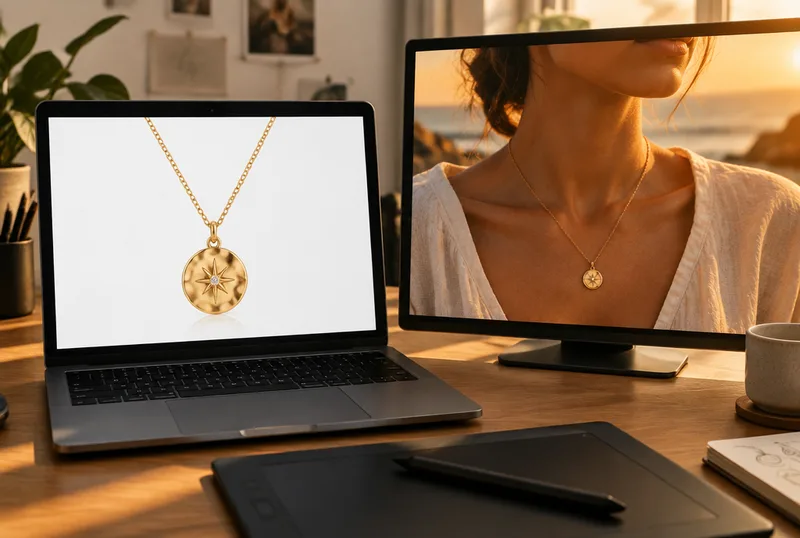
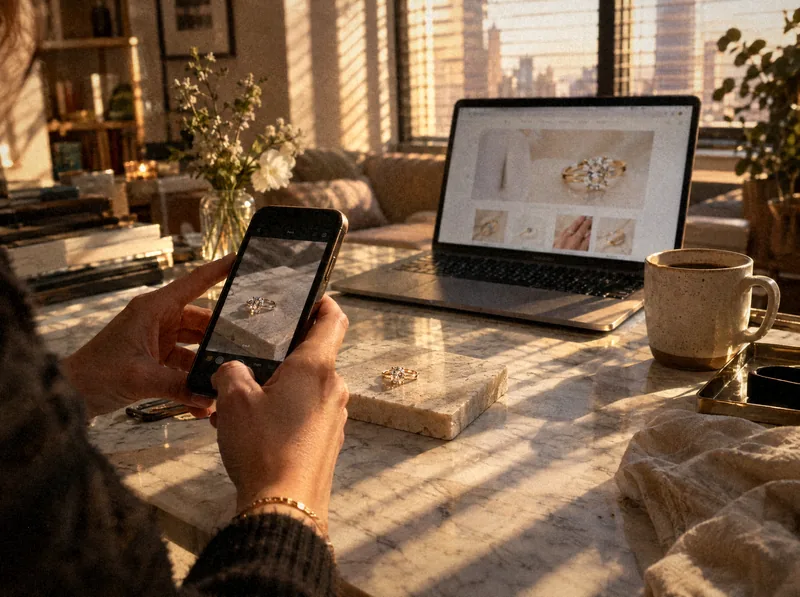
AI product photography for jewelry works best as a second step, not a first. You start with 1 sharp photo of the real piece. AI builds the hand, the model, the light and the scene around it. Done well, it gives a brand on-hand, on-model and lifestyle images for every product in days. Done badly, it quietly changes the piece, and the buyer notices when the box arrives.
I run my own fine-jewelry brands as well as Grandior. With AI images, the generator is never the hard part. Checking every frame against the real piece is.
What is AI product photography for jewelry?
It is a real photo of your piece, placed by AI into an image that would otherwise need a model, a studio or a location. The jewelry comes from the camera. The hand, the neck, the light and the room come from the model.
That is different from asking a generator to "draw a gold tennis bracelet". A generated bracelet is not your bracelet. It might be close, but stone count, setting and proportions are guesses. For a product page or an ad, the piece has to be the one you ship.
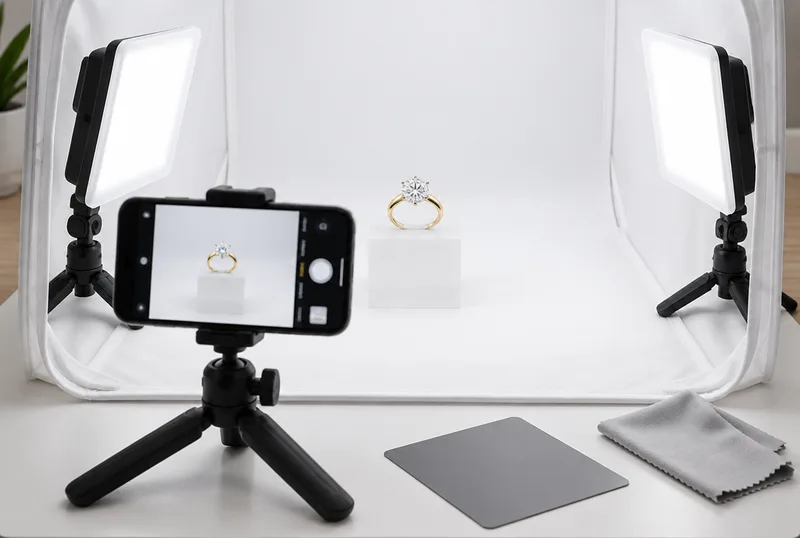
So the input matters most. Two or three sharp photos of each piece on a plain background, in true color, are the base. If you need to make those yourself, our guide on how to photograph jewelry walks through a phone setup.
What does AI do well for jewelry brands?
Anything around the piece: hands, models, scenes and formats. These are the shots that cost the most to produce the old way.
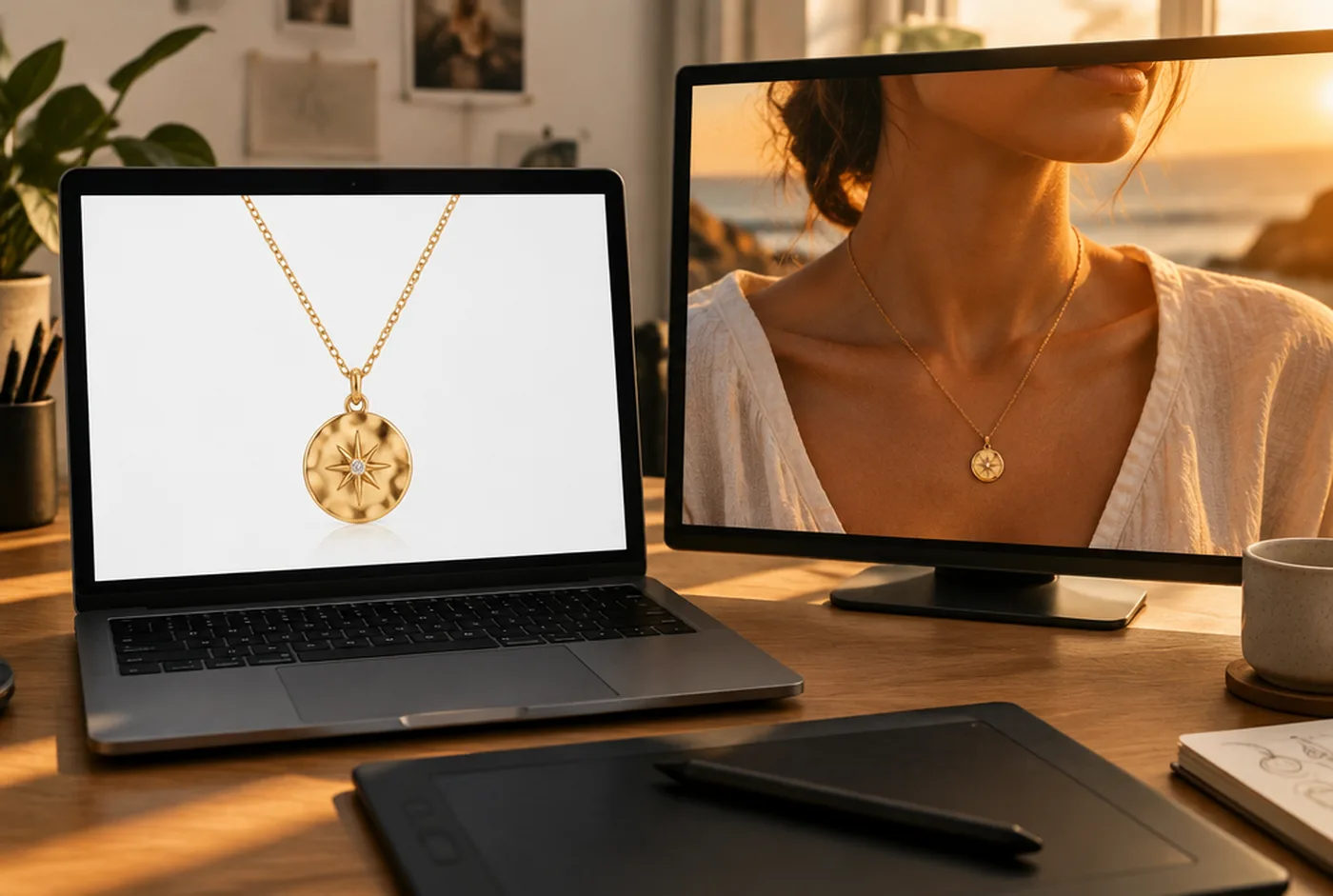
- On-hand and on-model shots. A ring on a hand, studs on an ear, a pendant at the collarbone. These answer the scale question that a packshot can't. Our engagement ring on hand photo guide covers that shot in depth.
- A range of hands and skin tones. The same piece on several hands, so more buyers see it on someone like them.
- Lifestyle sets. The piece worn at a café, on a beach, at a desk, in warm evening light. These carry ads, email and social.
- One look across a catalog. The same model, light and scene style on every product, so the grid looks like one brand.
- Backgrounds and crops. Clean white for the PDP, square for the feed, vertical for Reels and Stories.
- Video from stills. A slow turn, a glint of sparkle or a hand moving, made from photos.
- Metal color variants. AI can show a design in yellow, white or rose gold. This is where checking matters most, because the color has to match the alloy you ship.
For a full list of the shots each product needs and which ones suit AI, see our guide to jewelry product photography.
Where does AI product photography go wrong with jewelry?
In the details a jeweler would spot and a generator doesn't understand. These are the failures we check for on every image.
- Stone counts drift. A pavé band comes back with fewer stones than it has, or a halo gains a row.
- Prongs change shape. Claw prongs turn into rounded beads, four prongs become six, a basket setting loses its rail.
- Invented details. A plain gallery grows filigree, an engraving turns into made-up letters, a chain gets a clasp it doesn't have.
- Wrong scale. A small hand makes a stone look bigger. A pendant floats at the wrong height. Earrings sit where no piercing would be.
- Fake sparkle. Starbursts and glow that no real diamond makes. It looks cheap, and it misrepresents the stone.
- Metal color shifts. Rose gold turns copper, 14K yellow drifts toward 22K.
- Odd hands. Extra knuckles, merged fingers, a thumb on the wrong side, nails that change between frames.
- Physics. Chains that don't hang, rings that don't touch the skin, reflections of a room that isn't there.
Most of these are small at thumbnail size and obvious at full size. A buyer zooming in on a PDP sees them. Read our parts of a ring guide if you want the words to describe what changed.
How does Grandior's AI Studio keep the piece accurate?
By starting from your real piece and checking every image against it. In our AI Studio the process runs in four steps.
- Order. Pick a pack and pay by Stripe.
- Upload. We email an upload link within one business day. You send two or three sharp photos of each piece on a plain background, or your existing product shots.
- We create. Images are generated, retouched and checked against your real piece, so the stones, prongs and metal match it.
- You approve. Changes are included. Anything that drifts from the real piece, such as a prong, a stone count or the shape, gets redone.
Every pack keeps one model and look across your catalog, and files come back sized for Shopify, Instagram, Meta ads and email: square, portrait and vertical. Everything is yours to use on your store, social and paid ads.
What are the rules for AI images on Etsy, Google Shopping and in ads?
Show the real product, keep at least one real photo where it's required, and label AI where the rules ask. These are the rules we checked today, as of October 2026.
Etsy. Etsy updated its listing image requirements on 22 October 2026. For most products, a listing must include at least one unedited photo of the actual item against a real background, with no editing or AI on that photo. Other images may be edited or AI-enhanced if the result is still an accurate representation of the physical product. Changing a product's color, texture or condition, hiding defects, or using AI to change an item's core design is not allowed. Custom and made-to-order items should use photos of real, finished items made before (Etsy listing image requirements).
Etsy also recommends noting in the description whether images were edited (Etsy Seller Handbook). Sellers who have their own designs made by us can read how we work as an Etsy production partner.
Google Shopping. Google Merchant Center says the primary image must clearly display the exact item being sold, and all images created with generative AI must contain metadata saying so. Don't strip tags such as IPTC DigitalSourceType when you export (Google Merchant Center Help).
Ads in general. The FTC says "advertising must be truthful and non-deceptive", and judges an ad in context, pictures included (FTC Advertising FAQ's). A photo that makes a stone look bigger, whiter or brighter than the real one is misleading, whatever made it.
AI models in ads. New York already requires a conspicuous disclosure when an ad features an AI-generated "synthetic performer", and California's SB 1050 adds a similar rule from 1 January 2027 (Manatt). If you run AI model video as paid ads, ask your lawyer how to label it.
Which jewelry photo tasks is AI good at?
Most tasks around the piece, few tasks on it. Use this table before you publish.
| Task | AI good at it? | What to check before publishing |
|---|---|---|
| Packshot on white from a real photo | Yes, for clean-up and background | Edges, true metal color, nothing added |
| Ring on hand, studs on ear, pendant on neck | Yes | Scale, finger or ear placement, stone count |
| Same piece on 3 or more skin tones | Yes | Piece identical in every frame |
| Lifestyle scenes for ads and email | Yes | Light on brand, piece still exact at full size |
| Metal color variants | Partly | Color against a real sample of that alloy |
| Close-up of pavé or prongs | No, use a real macro | Count stones, compare prong shape |
| Engraving or hallmark close-up | No, use a real photo | Letters and marks exactly as made |
| 6 to 10 second video from stills | Yes, with review | No warping as it turns, no added sparkle |
| Etsy's required unedited photo | No, not allowed | Real photo, real background |
What does AI product photography cost at Grandior?
From $75 for one product down to $30 per product on the 50-product pack. Each product in a pack gets a white-background shot, an on-hand or on-model shot and two lifestyle scenes.
- Trial: $75 for 1 product, 4 images and 1 short video on a model. It comes back in 3 business days.
- Starter 10: $400 for 10 products, $40 each, with two rounds of changes.
- Studio 50: $1,500 for 50 products, with a kickoff call to set the scene and model style.
- Product video: $20 per 6 to 10 second video.
- Brand photoshoot: $1,000 for up to 10 products, with a moodboard and one consistent AI model.
Building a range with us? Pick designs from the lookbook or have your own made through custom design, then shoot the whole catalog the same way.
Next step
Test it on one piece. Order the $75 trial on the AI Studio page and check the result against your own jewelry. If you want a full catalog or a brand shoot, book a studio call and we'll plan it with you.
Questions founders ask
Is AI product photography good enough for jewelry?
For on-hand, on-model and lifestyle images, yes, when it starts from a sharp photo of the real piece and every image is checked against it. It is weaker on fine detail, so stone counts, prongs and engravings need a careful look before you publish.
Can AI change my jewelry design by mistake?
Yes. Generators can add or drop stones, reshape prongs, change a band's width or invent an engraving. Compare each image with the real piece at full size and redo any image where the piece has drifted.
Does Etsy allow AI product photos?
Yes, with limits. As of October 2026, most listings need at least one unedited photo of the actual item against a real background. Other images may use AI if they still show the physical product accurately. Etsy recommends noting edited images in the description.
Do AI images need to be labeled on Google Shopping?
As of October 2026, Google Merchant Center says images made with generative AI must contain metadata saying so, and you must not strip tags such as IPTC DigitalSourceType. The main image must still show the exact item being sold.
Do I have to disclose an AI model in my ads?
It depends where the ad runs. New York already requires a conspicuous disclosure when an ad features an AI-generated synthetic performer, and California's similar law takes effect on 1 January 2027. Ask your lawyer which of your ads it covers.
How much does AI product photography cost for jewelry?
At Grandior's AI Studio, a one-product trial is $75. Packs are $400 for 10 products and $1,500 for 50 products, and a product video is $20.
Sources
Checked on October 31, 2026. Rules and rates change, so confirm with the source before you rely on a number.
- Etsy, Listing image requirements (updated 22 Oct 2026)etsy.com
- Etsy Seller Handbook, Important updates to AI use on Etsyetsy.com
- Google Merchant Center Help, Image requirementssupport.google.com
- FTC, Advertising FAQ's, A Guide for Small Businessftc.gov
- Manatt, California joins New York in requiring disclosure of synthetic performers in advertisingmanatt.com
Get new guides by email
Practical guides for jewelry brands, from what we see on real orders. Only new guides; unsubscribe any time.