Short answer
A ring has up to 10 named parts: shank, shoulders, gallery, head or basket, prongs, bezel, bridge, hidden halo, halo and pavé. The stone adds 5 more: table, crown, girdle, pavilion and culet. Name each part in your brief. Custom CAD at Grandior starts from $55 per design.
- Ring parts
- Up to 10 (shank to pavé)
- Stone parts
- 5 (table, crown, girdle, pavilion, culet)
- Prongs on a round center stone
- Usually 4 or 6 (GIA)
- Custom CAD from
- $55 per design
In this guide11 sections
"Thin band, pretty setting" is a brief that costs rounds of CAD. "1.8 mm comfort-fit shank, six claw prongs, hidden halo" gets a close first render. The gap between them is knowing the parts of a ring: up to 10 named parts (shank, shoulders, gallery, head or basket, prongs, bezel, bridge, hidden halo, halo, pavé), plus 5 on the stone (table, crown, girdle, pavilion, culet).
I run my own fine-jewelry brands as well as Grandior, and I read a lot of briefs. The ones that move fastest name each part and put a millimeter figure next to it. Each part changes how the ring wears, how it looks and what it costs to make.
What are the parts of a ring called?
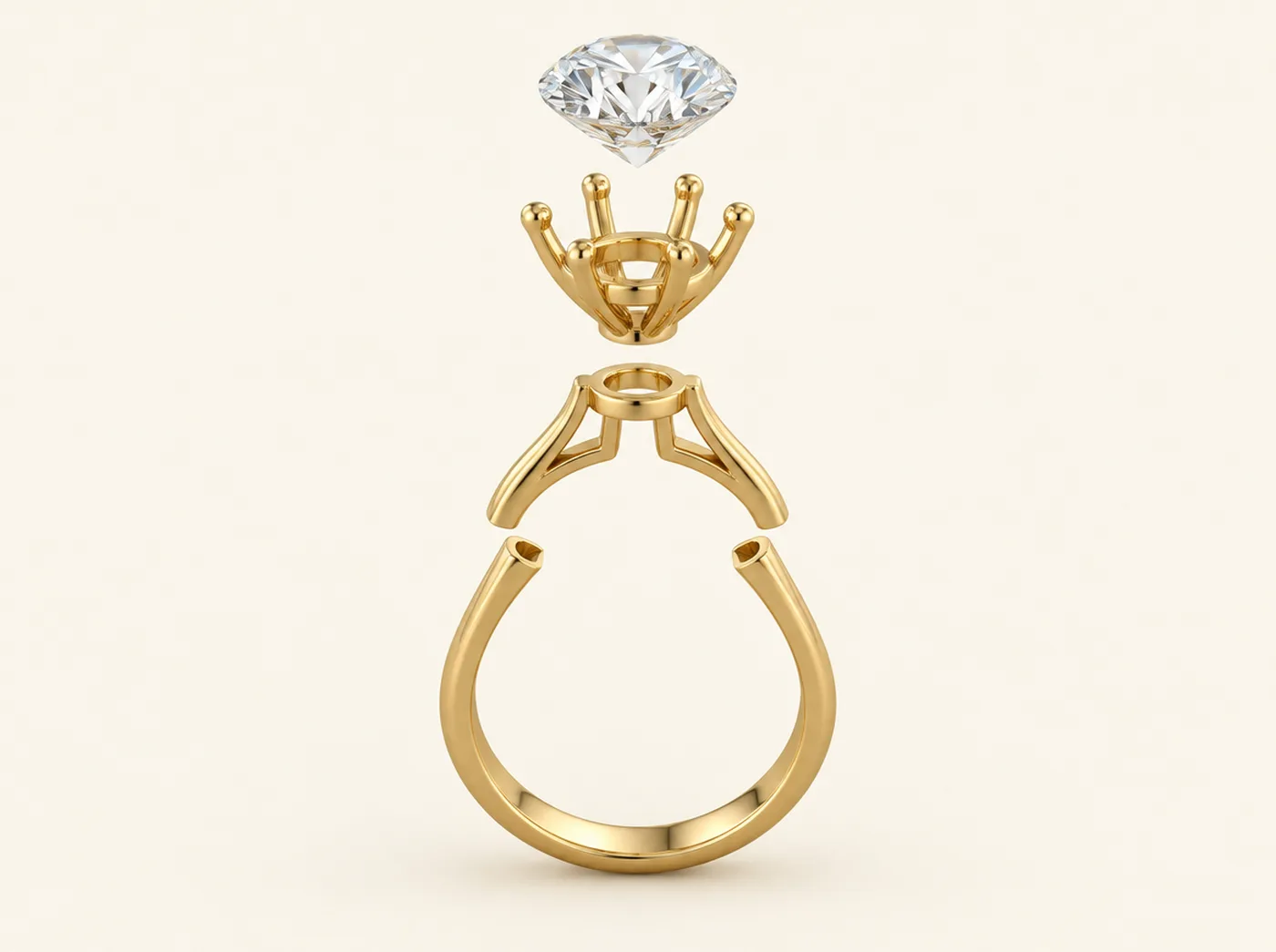
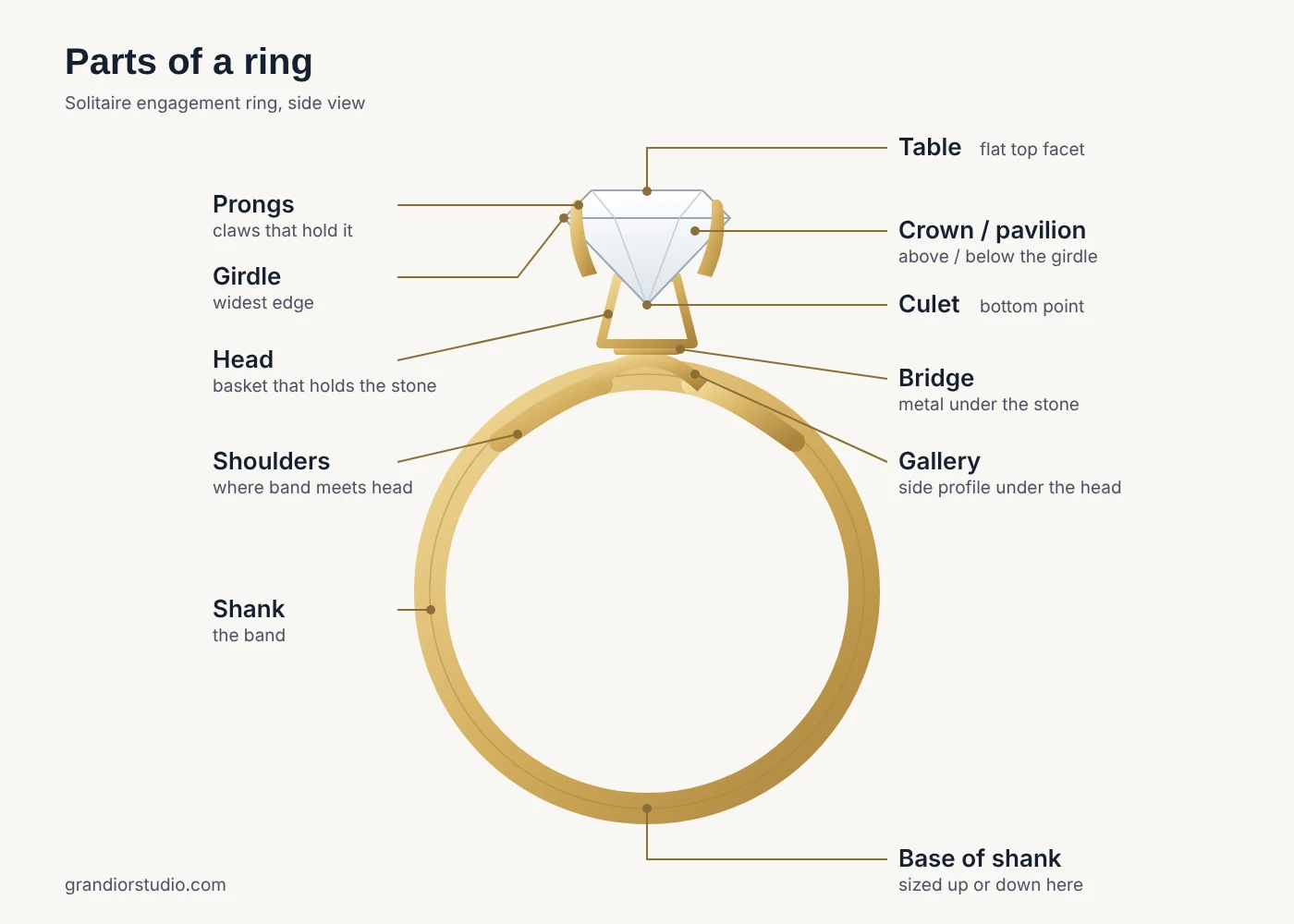
The core is the shank, shoulders, head and stone, with the gallery under the head. Everything else is an option you add. From the bottom up:
- Shank (band): the circle of metal around the finger.
- Shoulders: the top sides of the shank, where it rises to meet the head.
- Gallery: the side view under the head. Open, closed or decorated.
- Head or basket: the structure that holds the stone.
- Prongs (claws): metal tips that grip the stone.
- Bezel: a metal wall that wraps the stone instead of prongs.
- Bridge: a bar under the head that joins the two sides of the basket and sits near the finger.
- Hidden halo (under-gallery): small stones set around the head, below the center stone.
- Halo: a ring of small stones around the center stone, seen from the top.
- Pavé: small stones set close together along the band.
What does the shank do, and how should you specify it?
It holds the ring on the finger and carries most of its metal, which makes it the biggest single driver of metal weight. Go wider or thicker and you add grams. In gold, every gram shows up in the price.
Give your maker four things:
- Width in millimeters, measured at the base of the ring.
- Thickness in millimeters, inside to outside.
- Profile: flat, half-round, knife-edge or tapered toward the top.
- Inside finish: standard, or comfort fit, which is rounded inside so it slides over the knuckle more easily.
A thin shank looks delicate and makes the center stone look bigger. It also bends more easily. Ask your maker for the minimum thickness they'd recommend in your metal and karat, and believe them.
What is pavé, and what does it cost?
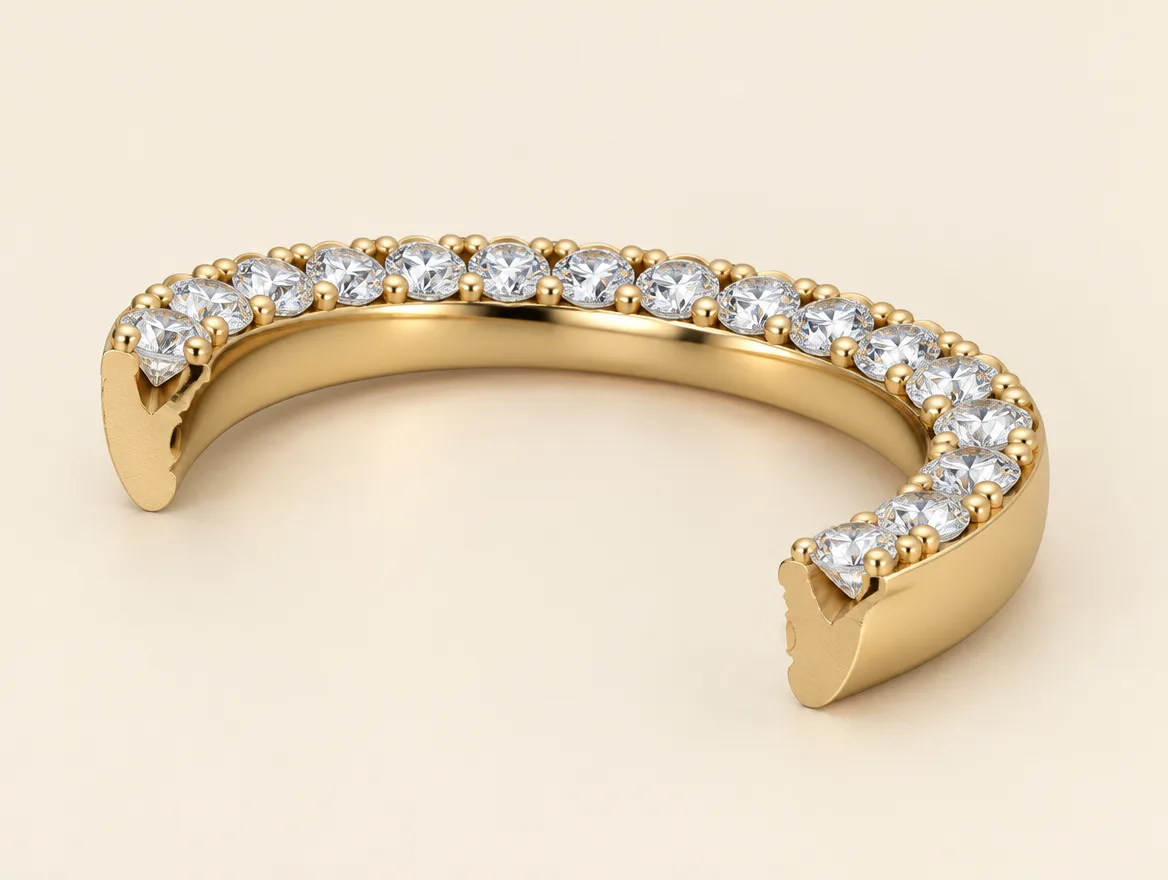
Pavé is a row of small stones set close together in the band, each held by tiny beads of metal raised by the setter. The GIA guide to ring settings notes it may need occasional maintenance to keep the stones secure.
It adds three costs: the small stones, the setting time for each one, and a shank thick enough to hold them. Say how far the pavé runs: halfway, three-quarters or all the way round. A band set all the way round has no plain metal to cut, so resizing it is hard.
What are the shoulders and the bridge?
The shoulders are where the shank rises to meet the head. A cathedral shoulder sweeps up in two arches to carry a raised head. A straight shoulder keeps the stone lower, closer to the finger.
The bridge is a small bar under the head that joins the two sides of the basket. It stiffens the basket, and it's a good spot for a signature detail only the wearer sees: a small stone, or an engraved mark.
For both, give your maker a height. A taller setting shows off the stone and lets a wedding band sit flush underneath. A lower one snags less on knitwear and gloves.
What holds the stone: the head, prongs or a bezel?
The head. It's either a basket of metal wires ending in prongs, or a bezel, a thin wall of metal wrapped around the stone's edge.
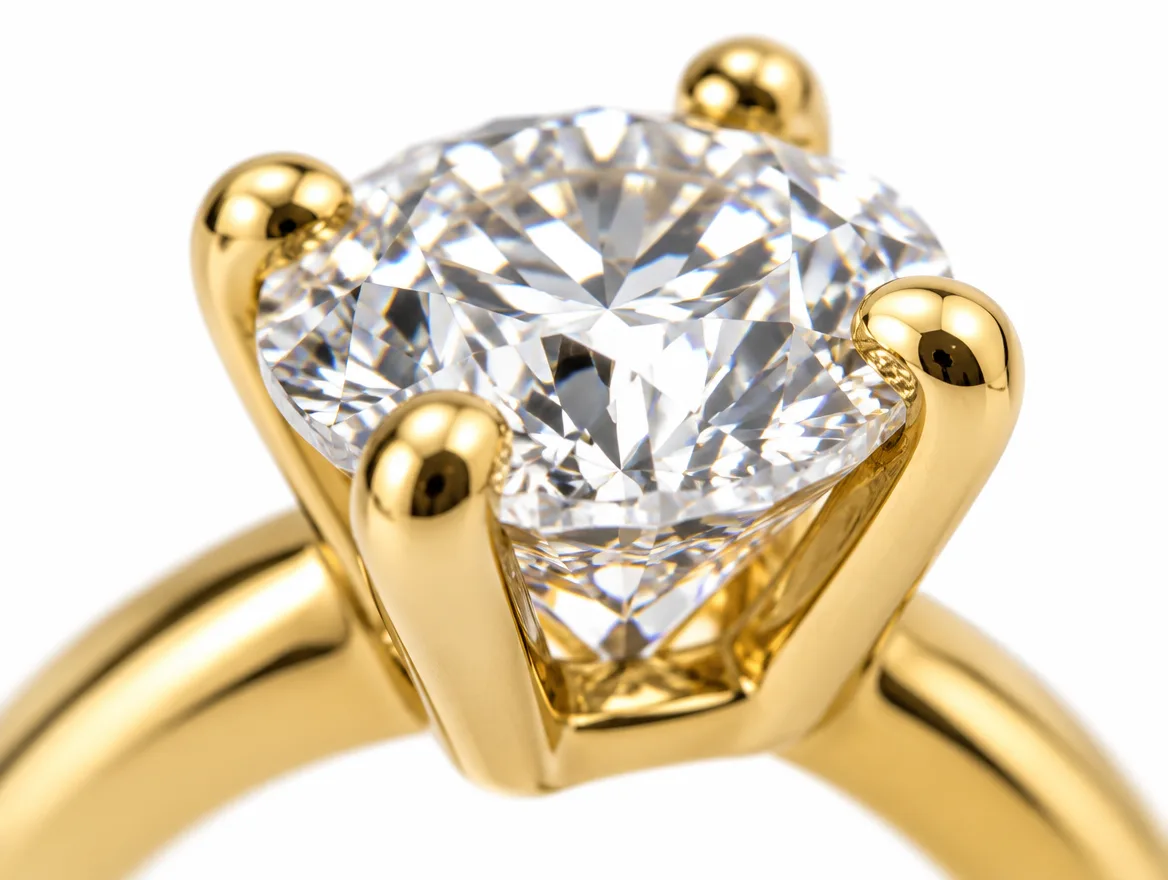
Prongs let in the most light and show the most stone. GIA notes that most round brilliant rings use four or six prongs, depending on stone size. Six grip more points and read rounder. Four show more stone and suit square shapes such as princess and cushion. Pointed shapes such as pear and marquise need a V-prong or a claw at each point to protect the tip.
Specify the count, the tip (round, claw, flat or double) and the placement on fancy shapes.
Bezels protect the stone's edges. GIA calls them a practical, durable choice for everyday wear. A bezel uses more metal than prongs and hides a little of the stone. Say full bezel or half bezel, which leaves two sides open.
What are the gallery, the hidden halo and the halo?
The gallery is what you see from the side, under the head. A plain gallery is quick to make. Scrollwork, cut-outs or a row of small stones mean more CAD time and more time at the polishing bench.
A hidden halo is a row of small stones around the head, just under the center stone. You see it from the side, not face up, so it adds sparkle without changing the top view. Some call it an under-gallery halo.
A halo is a ring of small stones around the center stone, seen from the top. GIA notes it can make the center stone look larger. Specify each halo stone's size in millimeters, the count and the halo's metal color.
Hidden halo, halo and side-stone designs make up a large share of our lookbook. Every design there lists its stones: center, side stones and accents, with total carat weight.
What are the parts of a diamond?
Five: table, crown, girdle, pavilion and culet. GIA's diamond anatomy guide defines them:
- Table: the large flat facet on top.
- Crown: the upper part, from the girdle up to the table.
- Girdle: the narrow edge between crown and pavilion. Prongs or a bezel hold the stone here.
- Pavilion: the lower part, from the girdle down to the culet.
- Culet: the small facet at the bottom point, meant to stop chipping.
The girdle matters most for durability. GIA notes that a very thin, knife-edge girdle makes a diamond more fragile and likely to chip, and prefers medium to slightly thick. If you sell rings people wear every day, check the girdle on the grading report.
Parts of a ring: what to tell your manufacturer
Name the part, give a size, say what it should do. That's a brief a CAD designer can model on the first pass.
| Part | What it does | What to specify |
|---|---|---|
| Shank | Holds the ring on the finger; most of the metal weight | Width and thickness in mm, profile, comfort fit or standard, ring size range |
| Shoulders | Shape the side profile | Straight, tapered or cathedral; any stones on them |
| Gallery | Side view under the head | Plain, open, scroll or stone-set |
| Head or basket | Holds the stone | Height above the shank, basket style |
| Prongs | Grip the stone | 4 or 6, tip shape (round, claw, flat, double), V-prongs for points |
| Bezel | Wraps and protects the stone | Full or half bezel, wall height |
| Bridge | Joins the basket sides | Plain, stone-set or engraved detail |
| Hidden halo | Side sparkle under the stone | Stone size in mm and count |
| Halo | Frames the stone face up | Stone size in mm, count, metal color |
| Pavé | Sparkle along the band | Stone size in mm, coverage (half, three-quarter, full) |
| Center stone | The focal point | Shape, carat or mm size, color, clarity, certificate, lab-grown or natural |
Add the metal and karat: 925 silver, gold vermeil, or 10K, 14K or 18K gold. Our lookbook gives metal weights for 14K gold at US size 6. All weights and sizes there are indicative and final only after production.
How do the parts of a ring change production cost?
Cost follows metal, stones and labor, and every part adds to at least one of them.
- Metal: the shank, a bezel and cathedral shoulders add the most grams.
- Stones: a halo, hidden halo and pavé add many small stones, each counted in the quote.
- Labor: every small stone is set by hand. A pavé band or halo takes far longer on the setter's bench than a plain solitaire.
- CAD: a simple solitaire is quick to model. A detailed gallery, split shank or two-stone head takes longer.
At Grandior, custom CAD starts from $55 per design and complex designs from $250. Production is quoted per design, line by line, so you can see which part moves the number. The design belongs to your brand once paid for. See how we work as a custom jewelry manufacturer.
Which words should go on your product pages?
The same ones you used in the brief. "Hidden halo", "pavé band" and "six-prong solitaire" tell a buyer exactly what's in the box.
Disclose lab-grown stones every time. Under the FTC Jewelry Guides, a stone name for a lab-grown product must be immediately preceded by a word such as "laboratory-grown" or "laboratory-created", with equal conspicuousness (16 CFR 23.25, as of October 2026). Write "lab-grown diamond", never plain "diamond".
Next step
Browse the lookbook to see 500+ designs with their stones listed, or send a brief that names each part of your ring. Every order is dispatched within 7 days of confirmation. Custom work can take longer, so timelines are confirmed per order.
Questions founders ask
What are the parts of a ring called?
The band is the shank. The sides of the shank near the top are the shoulders. The part that holds the stone is the head, made of a basket with prongs or a bezel. The side view under the head is the gallery. Optional parts are the bridge, hidden halo, halo and pavé.
What is the anatomy of an engagement ring?
An engagement ring is a shank, shoulders, a head that holds the center stone, and a gallery under the head. Many designs add a hidden halo, a halo or pavé on the band. The center stone has its own parts too, from the table on top to the culet at the point.
What is the part of a ring that holds the stone?
The head, also called the setting. In a prong head, a basket of metal wires ends in prongs that grip the stone. In a bezel head, a thin wall of metal wraps the stone's girdle.
Is the shank the same as the band?
Yes, in everyday use. Jewelers say shank for the whole circle of metal and use band for plain rings or for the shank of an engagement ring. On a production brief, shank is the clearer word.
Are 4 or 6 prongs better?
Neither is better in every case. GIA notes most round brilliant rings use 4 or 6 prongs depending on stone size. Six prongs give more grip and a rounder look. Four show more of the stone and suit squarer shapes.
What is a hidden halo on a ring?
A hidden halo is a row of small stones set around the head below the center stone. You see it from the side, not from the top. It adds sparkle without making the ring look bigger face up.
Sources
Checked on October 31, 2026. Rules and rates change, so confirm with the source before you rely on a number.
Get new guides by email
Practical guides for jewelry brands, from what we see on real orders. Only new guides; unsubscribe any time.