Short answer
Most small brands need a jewelry photographer for a few hero, campaign and press images each season, not for every catalog shot. Hire one for macro detail and the brand's signature look. Use AI for catalog volume, every metal and on-hand shots. Grandior's AI Studio is $400 for 10 products.
- What a pro adds
- Macro work, focus stacking, controlled reflections, stone-true retouching
- Studio rate check
- Squareshot counts a jewelry image as 2 credits, $45 to $60 a credit (October 2026)
- AI catalog
- $40 per product on Starter 10, $30 on Studio 50
- AI brand shoot
- $1,000 for 40 images and 8 videos
In this guide9 sections
A jewelry photographer earns the fee on the hard shots. A 2 mm pavé band sharp from end to end. Polished gold without the room reflected in it. A diamond that sparkles without looking retouched. Most small brands need that skill for a handful of hero and campaign images each season. They don't need it for every catalog frame in every metal.
I run my own fine-jewelry brands as well as Grandior. On both sides, the photo list grows faster than the budget. The trick is spending a photographer's rate where it shows, and nowhere else.
What does a good jewelry photographer actually do?
A good jewelry photographer controls light on tiny, mirror-like objects. That is a narrow skill, and it's different from shooting clothes or skincare. Four things set the work apart:
Macro. Jewelry is shot close, often with a macro lens, so a 1.5 mm side stone fills enough pixels to read clearly.
Focus stacking. Up close, depth of field gets very shallow. The photographer shoots several frames at different focus points and blends them, so the front prong and the back of the band are both sharp.
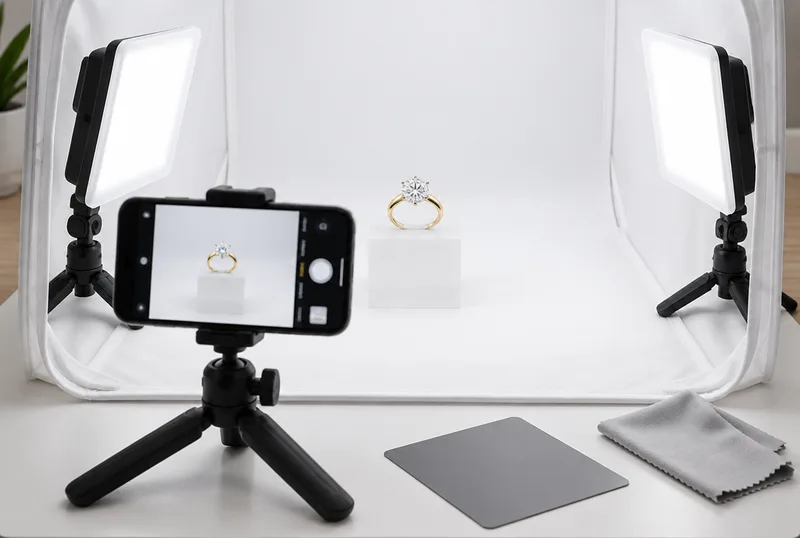
Reflection control. Polished gold and platinum reflect everything, including the camera. Jewelry photographers use white cards, black cards and diffusion tents to shape what the metal mirrors. Good polished gold shows smooth gradients, not your ceiling.
Retouching. Dust, fingerprints, polishing marks and stray reflections come out. The stone stays as it is. The FTC Jewelry Guides warn that showing a gemstone larger than its actual size may mislead buyers unless the true size is disclosed (16 CFR 23.1, as of October 2026). A good retoucher knows where cleaning stops and changing starts.
Do you need a jewelry photographer for your whole catalog?
Usually not. Catalog images need to be accurate and consistent. Hero and campaign images need a point of view. Only the second needs a photographer's eye.
| Job | Jewelry photographer | Grandior AI Studio |
|---|---|---|
| Catalog packshots in every metal | Squareshot: 2 credits per jewelry image, $45 to $60 a credit | $30 to $40 per product, four images each |
| On-hand and on-model images | Squareshot: 3 credits per hand-model image; soona hand model $79 an hour | Included for every product in Starter 10 and Studio 50 |
| Short product video | soona: $93 per clip | $20 per video |
| Campaign with a moodboard | Day or half-day shoot, quoted per project | $1,000 brand shoot, 3 scenes |
| Press and retail buyer images | Best choice | Not the right tool |
| One-of-a-kind natural stones | Best choice | Not the right tool |
Studio rates are from Squareshot and soona, checked October 2026. For a full breakdown of the sums, read our guide to product photography cost.
How do you vet a jewelry photographer's portfolio?
Look past the mood and check the hard parts. A portfolio full of watches and perfume tells you little about rings. Ask to see jewelry, and look at it full size:
- Diamonds. Facets should be crisp, with contrast between light and dark areas. A stone that looks evenly white with no pattern has often been over-edited. Fake starbursts are a warning sign.
- Polished gold. Look for smooth gradients across a band or a signet face. Black smudges or a visible camera reflection mean the reflections were not controlled.
- Metal colors. Yellow, white and rose gold should look like three different alloys. If rose looks like yellow, your customer will see a different ring arrive.
- Pavé and side stones. Every stone should be sharp, not just the front row. This is where focus stacking shows.
- On-hand work. Hands should be in proportion to the ring, with even skin texture and clean, neutral nails.
Then book a paid test on your hardest piece: a pavé band, a high-polish signet or a long chain. One image tells you more than a hundred in a portfolio.
How should you brief a jewelry photographer?
Brief with a shot list, not a mood. A good brief lets the photographer price the job accurately and saves you a reshoot. Put these in writing:
- Designs and versions. Every design, in every metal you want shown. Say which pieces are lab-grown so captions stay right.
- Angles per category. For example, rings at three-quarter view, top-down and side profile. Earrings front-on and on-ear.
- Background and crop. Background color, the product's size in frame, and the aspect ratios your store and social channels need.
- Retouching rules. Clean dust, scratches and reflections. Never change stone size, color or count.
- Usage. Where you can use the images, for how long, and whether ads are included. Get it in the contract.
- Rounds and files. How many rounds of changes, file formats and naming, so images drop straight into your store.
Ship pieces insured, with a packing list, and agree who is liable while they are on set.
How long does a jewelry photographer take?
Longer than the shoot day. You wait for a booking slot, ship the pieces, shoot, choose selects and go through retouching rounds. As a published reference, Squareshot states 8 days from payment to final shots, and soona lists edits back in 72 hours on its studio pass, counted after the shoot. Both checked October 2026.
Freelancers vary more. Ask for the date you will have final, retouched files in hand, not the shoot date.
For comparison, our $75 trial comes back in 3 business days, Starter 10 in 5 and Studio 50 in 10. After you order, we email an upload link within one business day.
When is AI Studio the better buy than a jewelry photographer?
When the job is volume and accuracy rather than a new look. That covers most of a young brand's year:
- Catalog images. Every design on white, the same angle and light, so the grid looks like one brand.
- Every metal. A design sold in three gold colors needs three sets of images.
- On-hand at scale. Rings sell on hands, and hand models bill by the hour.
- Fast launches. A drop that goes live in two weeks can't wait for a studio slot.
- Restocks and new stone sizes. Five new designs mid-season don't justify a shoot day.
How it works: you send two or three sharp photos of each piece, or your existing product shots. Our AI Studio makes the white-background, on-hand or on-model and lifestyle images around them. Then each image is checked against your real piece. If a prong, a stone count or the shape drifts, it gets redone.
If you make lookbook designs with us, private label pieces already come with studio shots in every metal. For the full method, see our guides to jewelry product photography and AI product photography.
What does a hybrid photo plan look like?
One photographer day for the brand, AI for everything else. A small brand can run a season like this:
- Hero and campaign. Book a jewelry photographer for your signature images: the homepage banner, the lookbook cover, the press kit.
- Catalog. Shoot each design on white with us, in every metal, using a Starter 10 or Studio 50 pack.
- On-model. Add an AI model photoshoot for on-model and on-hand images in one consistent look. Ring-specific tips are in our on-hand photo guide.
- Video. A $20 product video for each bestseller.
- Mid-season. New designs and restocks go into the next pack, not a new shoot.
Next step
Decide which images need a photographer's eye and which just need to be right. Then test AI on your hardest piece with the $75 trial on the AI Studio page, or book a call to plan the season.
Questions founders ask
Do I need a professional jewelry photographer?
For hero, campaign and press images, a good one is worth it. For catalog images in every metal, on-hand shots and restocks, AI photography made from your real pieces covers most small brands for far less.
How do I find a good jewelry photographer?
Look for jewelry in the portfolio, not just products. Check diamonds for clean facets and natural sparkle, polished gold for even reflections, and pavé for sharp stones end to end. Then pay for a test shot on your hardest piece.
How much does a jewelry photographer charge?
Rates vary by city and experience, so get quotes per image with retouching included. As a check, Squareshot in Brooklyn counts a jewelry image as 2 credits at $45 to $60 a credit, as of October 2026. See our full guide to product photography cost.
What is focus stacking in jewelry photography?
Shooting the same piece several times with the focus moved a little each time, then blending the sharp parts into one image. It keeps a whole ring sharp from the front prongs to the back of the band.
Can AI replace a jewelry photographer?
For catalog work, largely yes, as long as every image starts from your real piece and is checked against it. For campaigns, press and one-of-a-kind stones, a photographer is still the better buy.
Sources
Checked on October 31, 2026. Rules and rates change, so confirm with the source before you rely on a number.
- Squareshot: Pricingsquareshot.com
- soona: Pricingsoona.co
- FTC Jewelry Guides, 16 CFR 23.1ecfr.gov
- FTC: Advertising FAQ's, A Guide for Small Businessftc.gov
Get new guides by email
Practical guides for jewelry brands, from what we see on real orders. Only new guides; unsubscribe any time.