Short answer
Jewelry product photography for one product means about 9 shots: a packshot hero, 2 or 3 angles, a scale shot on hand, ear or neck, a lifestyle image, a detail macro, a short video, one hero per metal and a packaging shot. Grandior's AI Studio makes the scale, lifestyle and video shots from your packshot, from $75.
- Shots per product
- 9, from packshot hero to packaging
- Shopify image limit
- Up to 5000 x 5000 px, under 20 MB (October 2026)
- Etsy photo size
- At least 2000 px wide and tall recommended (October 2026)
- AI Studio
- $75 trial, $40 per product on Starter 10
In this guide8 sections
Jewelry product photography is a shot list, not one photo. Each product needs about 9 images: a packshot hero, 2 or 3 angles, a scale shot on hand, ear or neck, a lifestyle image, a detail macro, a short video, one hero per metal and a packaging shot. Plan the list once and the same set covers your PDP, your ads and every marketplace.
I run my own fine-jewelry brands as well as Grandior. The camera was never the hard part. The list was. Every new design, metal and stone size adds rows to it, and every missing row turns into a buyer question about size or color.
What shots does jewelry product photography need for each product?
Nine, and each one has a job. In the order a buyer usually sees them:
- Packshot hero. The piece on white or light grey, front or three-quarter view, filling most of the frame. It is your thumbnail on collection pages, Google Shopping and marketplaces, so it has to read at the size of a postage stamp.
- Angles (2 or 3). A side profile for setting height, a top-down view and the back: the gallery of a ring, the clasp of a bracelet, the post of a stud. Buyers turn the piece in their head. Give them the turn.
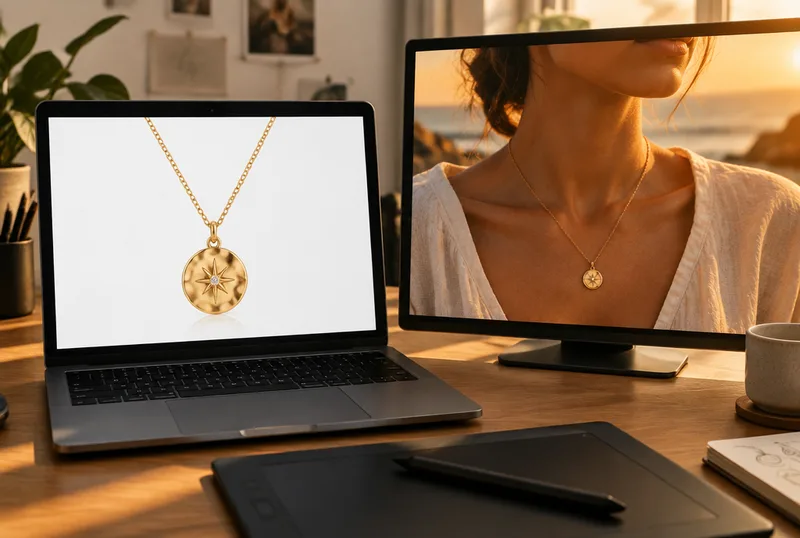
- Scale shot. Ring on a hand, earring on an ear, pendant on a neck. It answers "how big is it, really?" Our guide to the engagement ring on hand photo covers this shot in detail.
- Lifestyle. The piece worn in a real setting, in warm light. It sells the feeling, and it is the image that carries ads, email and social.
- Detail macro. Prongs, pavé, the clasp, the karat stamp, an engraving. It proves the finish. If you want to know what a buyer is looking for up close, read our guide to jewelry finishing.
- 360 or slow-turn video. Six to ten seconds of the piece turning. Sparkle and movement are the two things a still can't show.
- One hero per metal. Yellow, white and rose gold read differently on screen and on skin. A buyer choosing rose gold should see rose gold.
- Packaging shot. Your box, pouch and card. It shows the gift moment and answers "does it come boxed?" before anyone asks.
- One unedited real photo. Etsy requires it for most items. Everywhere else it quietly builds trust.
Which jewelry shots should come from a studio, and which from AI?
Real cameras for the shots that prove the piece. AI for the shots that put it in context.
| Image type | Where it's used | Studio or AI | What to check |
|---|---|---|---|
| Packshot hero | PDP image 1, collection grid, Google Shopping, marketplaces | Studio or your own setup | True metal color, clean edges, piece fills most of the frame |
| Side, top and back angles | PDP gallery | Studio or your own setup | Setting height and band width match the spec sheet |
| On hand, ear or neck | PDP image 2, ads | AI from your packshot | Scale true to size, stone count and prongs unchanged |
| Lifestyle | Ads, email, Instagram feed | AI | Light and mood on brand, piece still exact |
| Detail macro | PDP gallery, care and sizing pages | Studio, focus stacked | Pavé and prongs sharp from front to back |
| 6 to 10 second video | PDP, Reels, TikTok | AI from stills, or a studio turntable | No warping as it turns, no added sparkle |
| One hero per metal | Shopify variant image | Studio, or AI checked against a real sample | Color matches the alloy you ship |
| Packaging | PDP, gift guides, ads | Studio or your own setup | Your box and logo, no supplier marks |
| Unedited real photo | Etsy, required for most items | Your own camera | No edits, real background |
Anything a buyer uses to judge the physical piece should start from a real photo of it. Anything that shows it worn can be generated around that photo, as long as the piece never changes. We cover where that goes wrong in our guide to AI product photography.
If you have never seen a design in rose gold, don't let a screen be the first place you see it. Order a sample to check quality and color before you list a metal.
What does each image do on a PDP, in ads and on marketplaces?
On the PDP the packshot earns the click and the scale and detail shots earn the sale. In ads the lifestyle and video shots do the work. On marketplaces the rules decide.
Product page. Lead with the packshot hero. Put the scale shot second, because size is the first question after "do I like it?" Angles, macro and packaging follow. On Shopify you can add one image to each variant, and that image shows when a customer selects the variant (Shopify Help Center, as of October 2026). Attach the matching metal hero to each metal option.
Ads and social. A ring on white rarely stops a thumb. Lifestyle, on-model and short video do. Crop square for the feed, portrait for Instagram posts and vertical for Reels and Stories. Leave space at the top and bottom of vertical crops, where the app puts its buttons and captions.
What image specs do Shopify, Etsy and Google Shopping ask for?
Each platform sets its own sizes and rules, and they change. These are the basics we checked on each platform's own help pages, as of October 2026.
| Platform | Size | File limit | Rule worth knowing |
|---|---|---|---|
| Shopify | Up to 5000 x 5000 px or 25 MP; 2048 x 2048 px square usually displays best | Under 20 MB | One assigned image per variant |
| Etsy | At least 2000 px wide and tall recommended; first photo at least 635 px | Files over 1 MB may not finish uploading on slow connections | At least one unedited photo of the real item for most listings |
| Google Merchant Center | Around 1500 x 1500 px recommended; at least 500 x 500 px for all products from 31 January 2027 | Up to 64 MP and 16 MB | Main image must show the exact item; AI images must carry AI metadata |
Shopify. PNG is Shopify's first choice for product images, then JPEG (Shopify Help Center). Keep one aspect ratio across featured images so collection pages line up.
Etsy. Etsy crops thumbnails into square, portrait and landscape shapes (Etsy Help), so leave room around the piece. Its listing image rules, updated 22 October 2026, ask for at least one unedited photo of the actual item against a real background. For custom or made-to-order items, Etsy asks for photos of real, finished items you have made before (Etsy listing image requirements).
Google Merchant Center. The primary image "must clearly display the exact item being sold". No promotional overlays, watermarks or borders. Images made with generative AI must keep metadata saying so, such as the IPTC DigitalSourceType tag (Google Merchant Center Help). Lifestyle images go in their own attribute.
Amazon. Amazon keeps its image rules inside Seller Central. Read the current version in your account before you shoot a main image for it.
Why is jewelry photography harder than other product photography?
Because jewelry is small, shiny and judged on detail. A ring is smaller than a coin, so the camera sits close and only a sliver of it stays sharp. Polished gold works like a curved mirror and shows the whole room. Diamonds need light to sparkle, and too much light turns them into white blobs.
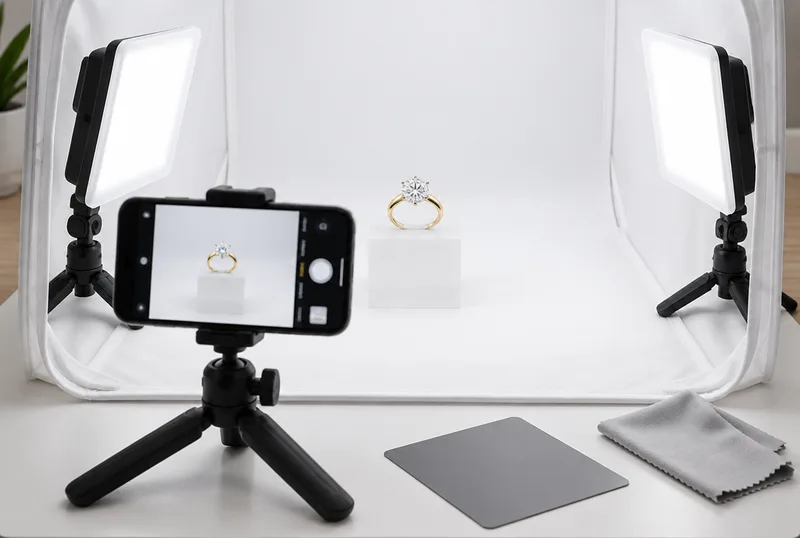
That's why good jewelry photography is mostly light control: a tent or diffusion around the piece, cards to shape reflections, and several frames blended for focus. You can do it at home with a phone. Our step-by-step guide on how to photograph jewelry walks through the setup, settings and editing.
How much does a studio day cost compared with AI images?
A studio day is priced by the day and by the people in the room. AI is priced by the product. Which costs less depends on how many products, metals and models you need.
A traditional shoot bills for the photographer, the studio and lighting, a hand or full model, often a stylist or nail tech, retouching per image and usage rights. You also need every physical piece there, in every metal, on the day. New designs next season mean a new day. Fine for a few hero pieces. For a catalog in three metals, it adds up fast.
At Grandior's AI Studio, you send two or three sharp photos of each piece and pay per pack:
- Trial: $75 for one product: 4 images and 1 short video on a model.
- Starter 10: $400 for 10 products, or $40 per product, with two rounds of changes.
- Studio 50: $1,500 for 50 products, or $30 per product, with a custom scene and model style.
- Product video: $20 per video, 6 to 10 seconds.
- Brand photoshoot: $1,000 for up to 10 products, with a moodboard and one consistent AI model.
Each product in a pack gets a white-background shot, an on-hand or on-model shot and two lifestyle scenes. Everything is yours to use on your store, social and paid ads. Building a range with us? Pick designs from the lookbook or bring your own through custom design, and shoot every piece the same way.
Next step
Start with one product. Order the $75 trial on the AI Studio page and see your own piece on a hand and in a lifestyle scene. Planning a full catalog across metals? Book a studio call and we'll map the shot list with you.
Questions founders ask
What photos do you need for a jewelry product page?
Plan on about 9. A packshot hero on white, 2 or 3 angles, a scale shot on a hand, ear or neck, a lifestyle image, a detail macro, a short video, one hero per metal and a packaging shot. The packshot does the most work, so make it the sharpest.
What size should jewelry photos be for Shopify?
As of October 2026, Shopify accepts images up to 5000 x 5000 px or 25 megapixels, under 20 MB. It says a 2048 x 2048 px square usually displays best. Keep the same aspect ratio across products so collection pages line up.
What is the best background for jewelry product photos?
White or very light grey for the packshot hero, because it reads cleanly as a thumbnail and passes marketplace rules. Use real surfaces, skin and settings for the lifestyle and scale shots further down the gallery.
Can I use AI jewelry photos on Etsy?
Yes, with limits. As of October 2026, Etsy requires at least one unedited photo of the actual item against a real background for most listings. Other images may use AI if they still show the physical product accurately.
Do I need a photo for every metal color?
Yes, if you sell more than one. Yellow, white and rose gold look different on screen and on skin. On Shopify you can attach one image to each variant, so the photo changes when a buyer picks a metal.
How much does jewelry product photography cost?
A studio day bills for the photographer, studio, models and retouching, and needs every physical piece in every metal. At Grandior's AI Studio, AI images start at $75 for one product and $30 per product on the 50-product pack.
Sources
Checked on October 31, 2026. Rules and rates change, so confirm with the source before you rely on a number.
- Shopify Help Center, Product media types and specificationshelp.shopify.com
- Shopify Help Center, Adding images to variantshelp.shopify.com
- Etsy Help, How to add listing photoshelp.etsy.com
- Etsy, Listing image requirements (updated 22 Oct 2026)etsy.com
- Google Merchant Center Help, Image requirementssupport.google.com
Get new guides by email
Practical guides for jewelry brands, from what we see on real orders. Only new guides; unsubscribe any time.